
Updates
on everything Geocodio
Geocodio Turns 12
Twelve years in, more than 100,000 users have trusted Geocodio to process over 166 billion addresses.

In 2014, if you needed to geocode more than 2,500 addresses a day, you had limited options: stop what you were doing, or sign a $10,000+ year contract with Google that wouldn't even let you store the data.
That was pretty much it.
Developers building location features watched their costs spiral. Researchers analyzing geographic data had to ration their API calls. Teams spent hours cleaning messy address data before they could even think about geocoding it, because other tools would squawk at anything less than perfect input. And anyone who needed to store their results, rather than just display them once, faced contract negotiations before they could get started.
We built Geocodio because we ran into those same problems. Our founders were building a map-based mobile app, ran into the same limits, and out of that frustration, built a solution. When other developers said they had the same problem, too, we launched it as a service anyone could use and called it Geocodio.
Twelve years later, well over a hundred thousand people have used Geocodio to process over 166 billion addresses.
This is a look back at what made that possible and what's ahead.
"It just works!"
The thing we hear most from customers is that Geocodio is the part of their stack they don't have to worry about.
They write the integration once, and it runs. No arbitrary license keys expiring. No surprise errors. No platform failures that take down production. When it's working, nobody notices it. Which is exactly the point.
That might sound like a low bar, but anyone who's worked with geospatial data knows it isn't. The licensing alone can be a nightmare. One customer told us they have thirty or forty license codes with a household-name vendor. The vendor kills their license codes arbitrarily, causing failures in production. Thirty or forty license codes... for one integration.
Another said a single month with a competitor's pricing would have put them out of business.
We've built Geocodio to be delightfully boring with no bad surprises. Predictable costs. Clear documentation. No storage restrictions. An API and spreadsheet upload tool that can handle messy, user-generated address data without demanding perfection first.
Look, we get it. Geocoding isn't glamorous. It's never going to be the hot thing Silicon Valley is talking about. But we're okay with that. We get immense satisfaction out of providing a boring, no-surprises service that, in the words of our customers, "just works!"
More than coordinates
From the very beginning, our customers have shown us that latitude and longitude are just the starting point.
And that's how we've built our product: understanding one customer and one use case, one at a time, thousands of times a year.
A compliance team needed census tracts to verify fair lending practices. A journalist needed congressional districts to analyze voting patterns. A logistics company needed timezone data so they knew the data they were getting back from their trucks across North America was accurately recorded. A healthcare researcher needed to understand the demographics of the communities impacted by cancer. A real estate platform needed to clean and standardize addresses from dozens of MLSs where—to put it gently—data quality varies wildly.
Geocodio CEO and Co-Founder Michele Hansen can often be heard saying that "addresses are doorways to pieces of information." Maps are only the tip of the iceberg.
Other providers were focused on maps, yet our founders realized there were a lot of people who were more interested in analyzing data. That was difficult when other geocoders didn't let people permanently store the data.
So we added data appends: census data, congressional and state legislative districts, school districts, timezones, and more.
The other geocoding services were API-only, and that's how we launched, too. But we quickly heard from a lot of people who weren't developers who also needed location data, so we added a spreadsheet upload option.
Organizations with high volume needs were tired of shockingly high bills for geocoding, so we created a flat-rate plan with a dedicated server, our Unlimited Geocoding plan, so they could budget predictably and process as much data as they needed.
Every major feature has come from listening to what customers were trying to do overall, understanding how existing solutions created extra work, and then figuring out how we could make that easier.
Customers often tell us they get back more data than they expected and find uses for it they hadn't planned on.
We were our own first customer, and "what would we want to happen if we were the customer in this situation?" is something we ask ourselves often. But it isn't just a hypothetical question. During Hurricane Harvey in 2017, when residents trapped by flooding posted their addresses on Twitter hoping for rescue, we built a tool that scraped, geocoded, and mapped addresses and shared the data with rescue teams. During the early months of the pandemic, we built an app to help people find grocery stores nearby with available curbside pickup slots.
But we're just one in a sea of well over a hundred thousand people who've used Geocodio.
What our customers have built
The work our customers do genuinely fascinates and motivates us every day. It's where we get our ideas for how to improve Geocodio, and it also reminds us how impactful an unglamorous building block like coordinates can be.
Investigative journalists at Bloomberg, The Washington Post, and ProPublica have used Geocodio as a data source for reporting that informs the public and holds institutions accountable. Red Cross volunteers across the country rely on Geocodio to coordinate disaster response. Financial institutions use Geocodio to comply with equitable lending laws to verify that they're serving different populations and neighborhoods fairly. Non-profits use it to connect voters to their representatives.
One customer called Geocodio "the Rosetta Stone of data:" the bridge between datasets that lets them discover new things. That's the kind of work we want to make possible.
Earning it every day
Today, over eighty percent of Unlimited subscribers have been customers for at least three years, and over half have been with us for five years or more. Some of those customers have been with us since 2014, the year we launched.
(We get a little bit excited when we see a support ticket or invoice from a customer with a user ID below 1,000.)
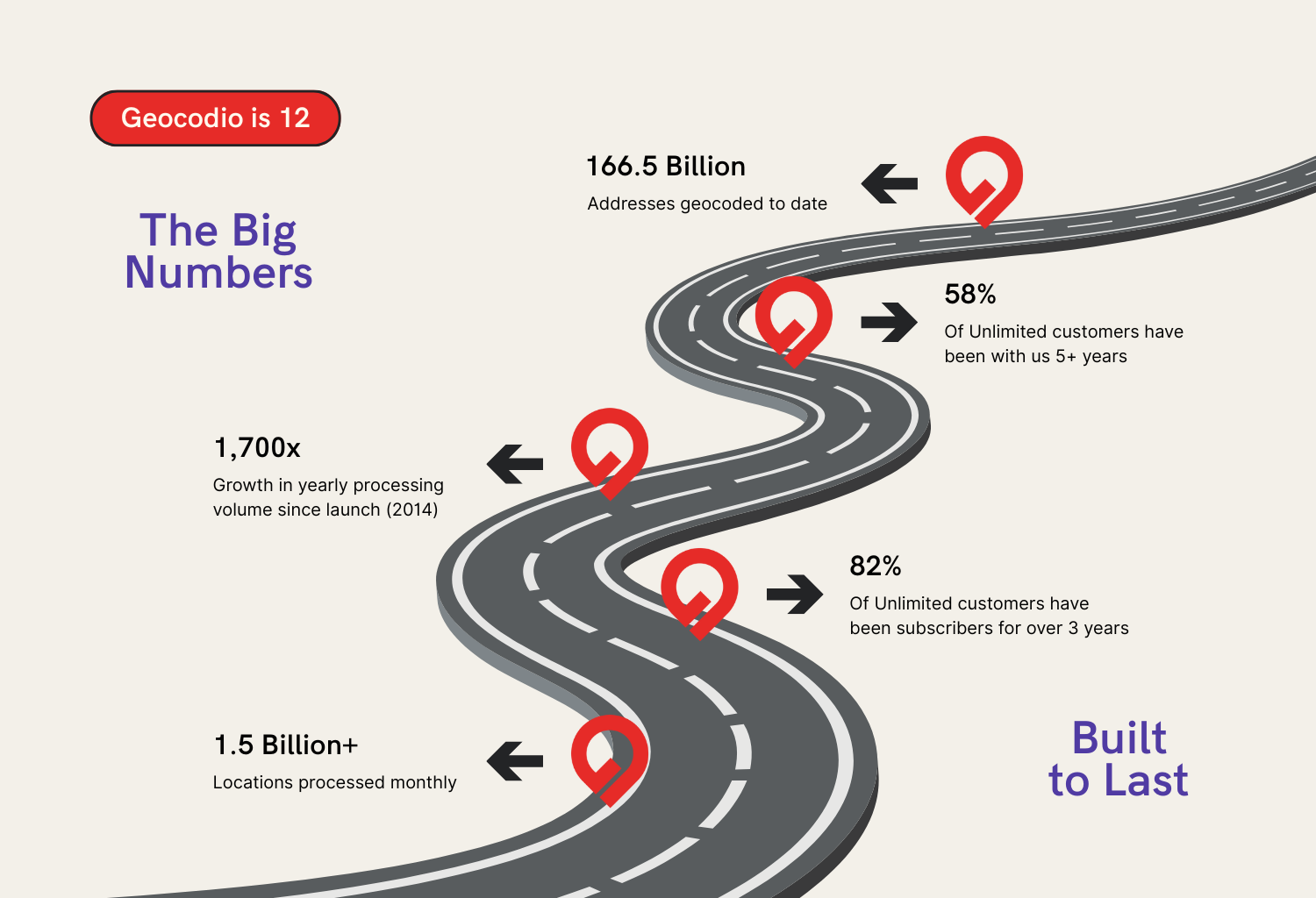
We know we have to earn that loyalty every day by providing a reliable, accurate, quietly boring service that lets you get on with your work while Geocodio hums along in the background.
Tens of thousands of people use Geocodio every month. Almost all of that growth has come through word of mouth: people who found that we solved their problem and told their colleagues about it.
Many of our Enterprise customers started the same way. One developer on a team tried us out for free, found that it just worked, and spread the word within their organization. As their needs grew, we grew with them. When our customers told us they now needed SOC 2 audit reports or on-premise deployment, we built an Enterprise tier to meet them where they were—while keeping the free, self-serve option that makes Geocodio accessible to all. Saving the solo developer or data analyst from banging their head against their keyboard due to the pricing or restrictions of major providers is core to who we are as a company, even if we have a stable of Fortune 50 customers.
What's ahead
We'll admit it. When we launched, our results weren't really our strongest selling point. The reasons people chose Geocodio back then were about price, data enrichment, and restriction-free storage, but not necessarily accuracy.
(That's part of why we get so excited, and surprised, when a customer from 2014 pops up.)
We've worked hard on accuracy over the years. We added rooftop geocoding in 2015 and deploy data updates nearly every day. A major geocoding engine upgrade in 2025 improved our average accuracy score to .981 out of 1, continuing a pattern of steady improvements that stretches back to those early days.
Last year's upgrade also paved the way for major new features that have long been customer desires, like driving distance calculations, which we launched last month, and expansion beyond the US and Canada, which is coming soon.
Thank you
On January 21, 2014, Geocodio rocketed to the top of Hacker News and we discovered just how many developers shared our frustrations with geocoding.
Ending those frustrations is why we're here, and you've made it possible ever since. Our customers have funded us from day one. Today, 166 billion addresses later, our mission is the same: make geocoding one less chore you don't have to worry about.
Thank you for twelve years. We're just getting started.
Related
2025 Geocoding Engine Upgrade
Geocodio has recently deployed a major update to the Geocodio geocoding engine.
Don't miss what's new
Geocodio ships new features and data updates regularly. We'll only email you with the good stuff, nothing else.
Thanks for subscribing! Check your inbox to confirm.